


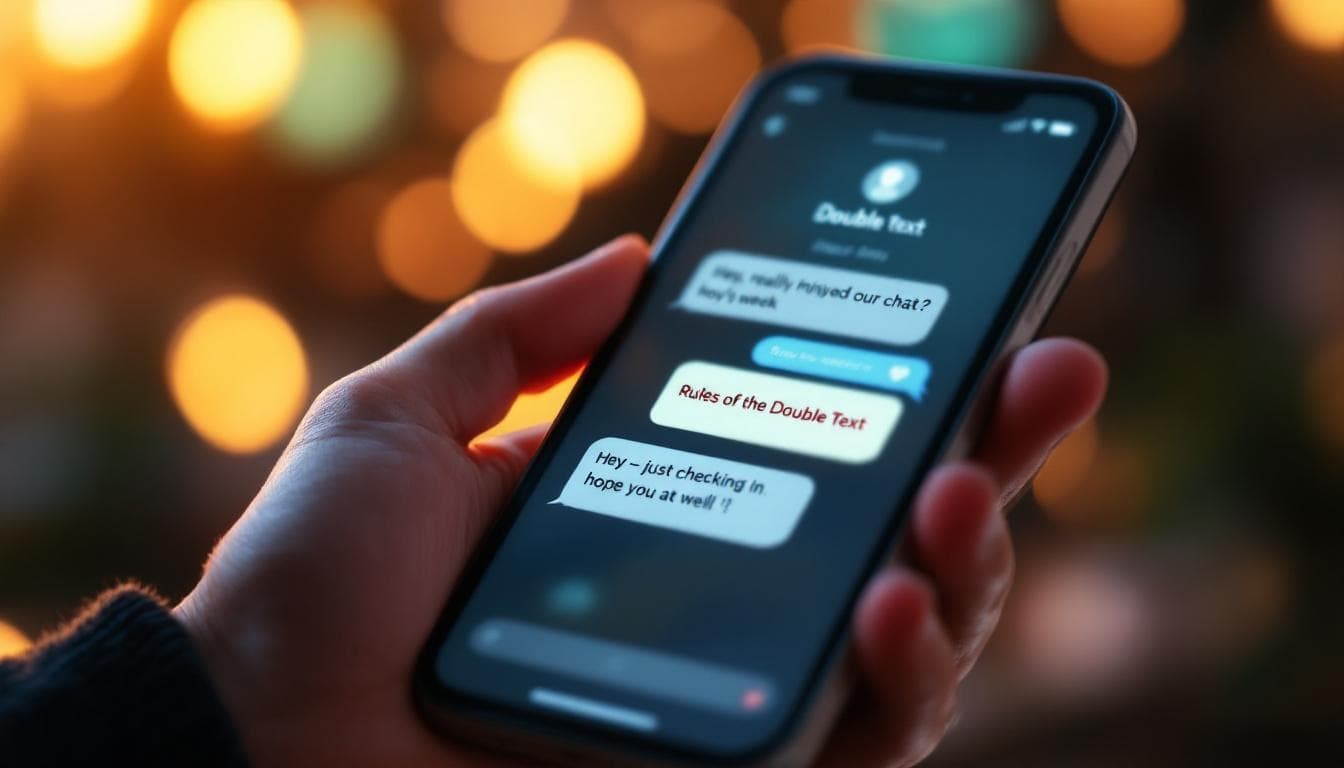
The Double Texting Dilemma
Double texting is worth doing in 5 specific situations and self-defeating in 3 others. The fear around it is mostly overblown -- confident persistence and desperation look nothing alike to her, and this guide shows you exactly where the line is. Below you'll find the green lights, the red lights, and what to actually say each time.
When to double text: the short answer
- Double texting is fine -- even smart -- in 5 situations: a logistical follow-up on pending plans, fixing a dead-end reply you sent, a callback to a shared joke, sharing something relevant to her interests, or a light check-in after 24-48 hours of silence.
- Never double text after a clear rejection, in rapid-fire succession, or with an accusatory tone -- each of these signals insecurity and kills attraction.
- The biggest mistake is treating silence as rejection. Most gaps in conversation are caused by busyness, not disinterest.
- How effective your follow-up feels to her depends heavily on your profile strength -- a bloke she's excited about gets the benefit of the doubt, a weak profile doesn't.
- Timing matters: for most scenarios, wait at least 24 hours before sending a second message.
When should you double text? Double text when your follow-up adds clarity or value, not pressure. That usually means plans are half-made, your last message killed the chat, you have a natural callback, or 24 to 48 hours have passed and the conversation had real momentum.
Should You Double Text Here? Quick Decision Table
Green Lights
| Situation | Wait | Send or Don't Send | Why | Opener Style |
|---|---|---|---|---|
| Plans are half-made | Same day or next morning | Send | Clears up logistics | Direct follow-up |
| Your last text was weak | A few hours to next day | Send | Fixes your own dead end | Reset with context |
| Shared joke or callback | 1 to 3 days | Send | Reopens a warm vibe | Playful callback |
| You found something relevant | When you have it | Send | Adds value instead of pressure | Thought of you |
| Good chat, then silence | 24 to 48 hours | Send | Gives her an easy re-entry | Light check-in |
Red Lights
| Situation | Wait | Send or Don't Send | Why | Opener Style |
|---|---|---|---|---|
| Clear rejection | Never | Don't send | Respect the no | None |
| You already sent one and panic-hit follow-up | Stop immediately | Don't send | Feels needy fast | None |
| You're annoyed and want to call it out | Until you're calm | Don't send | Adds pressure and drama | None |
Double text when it moves the conversation forward. Leave it alone when it is really about soothing your own anxiety.
Look your best on every dating app. In 10 minutes our AI generates realistic and high-performing dating photos designed to get more likes and dates.
- Get a profile you're proud of
- Drastically increase your matches
- Turn great matches into more dates
The Green Light: 5 Scenarios When You SHOULD Double Text
Okay, let's get to the good stuff. In these five specific situations, not only is it OK to double text, but it's often the smartest move you can make. It can be the difference between a conversation fizzling out and you securing a date.
The "Logistical Lifeline" Text This is the most straightforward and effective time to double text. You were in the middle of making plans, and she suddenly went quiet after you suggested a time or place. Why it Works: Your intent is crystal clear. You aren't just fishing for attention. You're trying to finalise a date. It's practical, direct, and shows you're serious about meeting up. Waiting around in this scenario just creates confusion. Example Scripts:
- "Hey! Just wanted to follow up on drinks for Thursday. Let me know if 7 pm still works for you."
- "Circling back on our museum plan for this weekend. No worries if you're swamped, just wanted to lock in one of our great first date ideas if you're still keen."
The "Conversation Fumbled" Recovery Look back at your last text. Was it a closed-ended question? Or worse, was it a one-word answer like "Yeah," "Cool," or "lol"? If so, the conversation's death might be on you. Why it Works: You're taking ownership for letting the conversation stall. This shows self-awareness, which is a very attractive quality. You're not blaming her for the silence. You're fixing your own mistake. Knowing how to start a conversation is one thing, but knowing how to keep it going is another. Example Scripts:
- "Haha, my bad, that last text was a total dead end. Anyway, I was going to ask about your trip to Italy..."
- "You know, I realise 'lol' is a terrible response. Let me try that again. What's the craziest thing that happened on your hiking trip?"
The "Callback Humour" Nudge A few days have passed since you had a fun, lighthearted chat. You shared an inside joke or bonded over a specific topic. Now is the perfect time for a gentle nudge. Why it Works: It immediately re-establishes the fun vibe you had before. By referencing a previous shared moment, the text feels natural and low-pressure, not random or needy. It reminds her why she enjoyed talking to you in the first place. Example Scripts:
- "Just saw a corgi and resisted the urge to ask if it was secretly you (ref: your Hinge prompt). Hope you're having a good week."
- "My Spotify just played that terrible 90s band we were making fun of. Thought you should know the universe is still conspiring against good taste."
The "Value-Add" Text She mentioned she was into a specific band, movie, type of food, or hobby. You stumble upon something related that you genuinely think she'd find interesting. Why it Works: This is the opposite of a selfish text. It's not a "hey, what's up?" message. It's a "hey, I thought of you" message. It proves you were listening and remembered the details of your conversation, which makes her feel valued. Example Scripts:
- "Hey, I remembered you said you were a huge fan of [Band Name]. They just announced a show in the city next month. Thought you'd want to know!"
- "This is random, but I just finished that book you recommended, and you were right, the ending was wild. We need to discuss."
The "Grace Period" Check-In (After 24-48 Hours) The conversation was going well, the vibe was good, but it's been a day or two of complete silence. Life gets in the way. People forget to reply. It happens to everyone. Before you send anything, it's worth reading the signs she's still interested over text -- they'll tell you whether a check-in is worth sending. Why it Works: After a reasonable amount of time, a simple and playful check-in is perfectly acceptable. It gives her an easy out if she genuinely got distracted and forgot to respond. The key is to keep it light and assume the best. Example Scripts:
- Playful: "Hey! You haven't been abducted by aliens, have you? Seemed like a real possibility."
- Direct and Confident: "Hey [Her Name], hope you're having a great start to your week. How did that project turn out?"
The Red Light: 3 Times You Should NEVER Double Text
Knowing when to act is only half the battle. Knowing when to hold back is just as important. Double texting in these scenarios will wreck your chances and can come across as creepy or insecure.
After a Clear "No" or Rejection This should be obvious, but it needs to be said. If she has explicitly told you she's not interested, unmatched you, or gave a very firm "I'm not looking for anything right now," you must respect her decision. Continuing to text her after this point isn't persistent. It's harassment. The conversation is over. Move on.
In Rapid-Fire Succession (The Panic Text) This is the big one. Sending a text, and then following up minutes or even a few hours later with more messages is the fastest way to kill attraction.
Hey
(15 minutes later) You there?
(1 hour later) ?
This behaviour screams insecurity. It communicates that you have nothing else going on and that your entire mood depends on her reply. Give her space. People have lives. Let them live them. According to Rest Less's UK dating research, each message creates a "communication debt" that can make recipients feel tense and resentful -- reason enough to resist the urge to pile on.
When You're Angry or Accusatory Never, ever send a passive-aggressive follow-up. Texts like, "Guess you're not interested anymore," or "I see you've been active online, so I guess you're just ignoring me," are massive turn-offs. This approach is manipulative and insecure. You're trying to guilt her into a response, and even if it works, you've started the interaction from a negative and toxic place. Your goal is to reignite a positive connection, not start a fight. It's a critical error many blokes make, similar to having a bad Tinder bio that complains about women.
The Psychology of the Double Text: Why We Fear It
The risk in double texting usually comes from bad timing or bad tone, not from sending one extra message. Most men overestimate how much one follow-up matters and underestimate how much context matters.
- A 2026 Psychology Today study of more than 500 participants found that texting the next morning after a date led to the strongest relationship intentions, more chemistry, and more motivation to meet again than texting immediately or waiting two days.
- Research in the Journal of Social and Personal Relationships found that texting too soon after a first date can make the sender seem needy and less desirable, while better timing improves romantic interest.
- Rest Less's UK dating research describes each extra message as "communication debt", which is why rapid-fire follow-ups so often backfire.
The takeaway is simple. Wait for a sensible window, send something that adds value, and stop the moment your follow-up starts feeling like pressure instead of momentum.
It's Probably Your Photos.

Average users see 8x more right swipes with our AI photos. Stop wasting time on dating apps and join 60,000+ singles who have already found better dates with TinderProfile.ai.
The Foundation: Why Your Profile Dictates Texting Success
Texting skill can reopen a good conversation, but it cannot rescue a weak first impression. If your profile already signals low effort, blurry photos, or the usual dating profile mistakes men make, even a well-timed follow-up will feel heavier than it should.
A stronger profile changes the way your messages are read. Better photos and a sharper bio make her more likely to assume you got busy too, not that you're chasing. That is why dating profile photo tips matter so much here. The same follow-up can land as confident from one bloke and needy from another, simply because the profile behind it creates a different first impression.
The Photo Problem and The AI Solution
If your photos are the real bottleneck, fix that first. Most blokes are working with weak inputs: old selfies, awkward angles, flat lighting, or a profile that never shows what spending time with them would actually feel like. A professional dating photo shoot can help, but it is expensive and still easy to over-stage. The data in our own dating app photo statistics points in the same direction as common sense. Better photos change results before you ever type the second message.
If you want the AI route, TinderProfile.ai is worth a look when your photos are the real problem, not your texting. The product is built to get you usable dating photos fast, with customers reporting 3x-8x more matches received on average and 7.9x more opening messages received. It is also ready in 10 minutes, has served 50,000+ customers, and holds a 4.8 / 5 star aggregate rating.
That matters because profile strength buys you margin. When your AI dating photos or regular photos already make a solid first impression, a follow-up reads like normal momentum. When the profile is weak, the same text can feel like effort she did not ask for.
How to Write a Double Text That Actually Gets a Reply
Knowing when to send a follow-up is only half the job. The other half is writing a message that doesn't feel like one. The same principles that apply to what to text her after getting her number apply here: low pressure, specific, and easy to reply to.
- Start with a callback, not a re-opener: Reference something from your previous conversation -- an inside joke, a topic she mentioned, or a question you'd asked. Cold openers ("Hey, you there?") signal you have nothing new to say.
- Keep it short: Your follow-up should be shorter than your original message. One or two sentences maximum. A short message is lower-pressure and easier for her to reply to.
- End with a question or an open door: Give her something easy to respond to. A closed statement ("Just checking in") leaves her nowhere to go. A light question ("How did that work presentation go?") gives her a natural hook.
- Match the tone of the original conversation: If you were playful, stay playful. If the conversation was more serious, don't pivot to jokes. Tone mismatch is jarring and signals you weren't paying attention.
- One follow-up only: If your double text doesn't get a reply, leave it. A third message -- unless it's a genuine logistical emergency for a date happening that day -- signals anxiety. The ball is in her court.
The best double text is one that could have been sent at any point in the conversation. It doesn't feel like a follow-up. It feels like you just thought of something worth sharing. That's the standard to hold yourself to before you hit send.
Conclusion: From Anxious to Confident
Stop viewing a silent phone as an automatic rejection. See it as an opportunity. A double text, when used correctly, isn't a gamble. It's a confident, calculated move.
You now have the playbook. You know the green lights: the logistical lifeline, the fumble recovery, the callback humour, the value-add, and the grace period check-in. You also know the red lights: never text after a clear 'no', in rapid-fire succession, or with an accusatory tone.
Armed with the right strategy, you can turn silence into dates. The next step is to make sure your profile gives you the best possible chance of success. Take a hard look at your photos. Are they making the right first impression? If not, you know what to do.
Frequently Asked Questions About When to Double Text
How long should I wait before I double text?
There's no magic number, but a good rule of thumb is to wait at least 24 hours. This gives her ample time to respond if she was just busy. For logistical texts about a pending date, you can follow up sooner, perhaps later the same day or the next morning.
What if she sees the message but doesn't reply?
Read receipts can cause a lot of anxiety. If she's read your message and hasn't replied, it's still best to wait 24 hours. She might have seen it while in a situation where she couldn't reply and then forgot. A gentle, low-pressure follow-up from one of the "Green Light" scenarios is your best bet.
Does double texting work differently on apps like Hinge or Bumble?
The psychology is the same across all platforms. The principles of being confident, low-pressure, and strategic apply whether you're on Tinder, Hinge, or Bumble. On Bumble, if she hasn't messaged first, you can't do anything. But once the conversation starts, these rules are universal.
Is it ever okay to triple text?
Almost never. The only remote exception might be a logistical emergency for a date planned that day (e.g., "Hey, I'm here at the bar!" followed by "Running 5 minutes late, traffic is crazy!"). Outside of that specific context, a triple text is a red flag that signals neediness. If two well-timed, strategic texts don't get a reply, it's time to move on.
When should you give up and stop texting her?
If a well-timed, non-pressuring double text goes unanswered for 3-5 days, it's a clear signal. Move on. The goal of the double text is to reopen a conversation that had genuine momentum, not to create interest where none exists. If she's not responding to two thoughtful, low-pressure messages, continuing to text crosses from persistence into pressure. Know when to leave the door open -- and when to close it.