


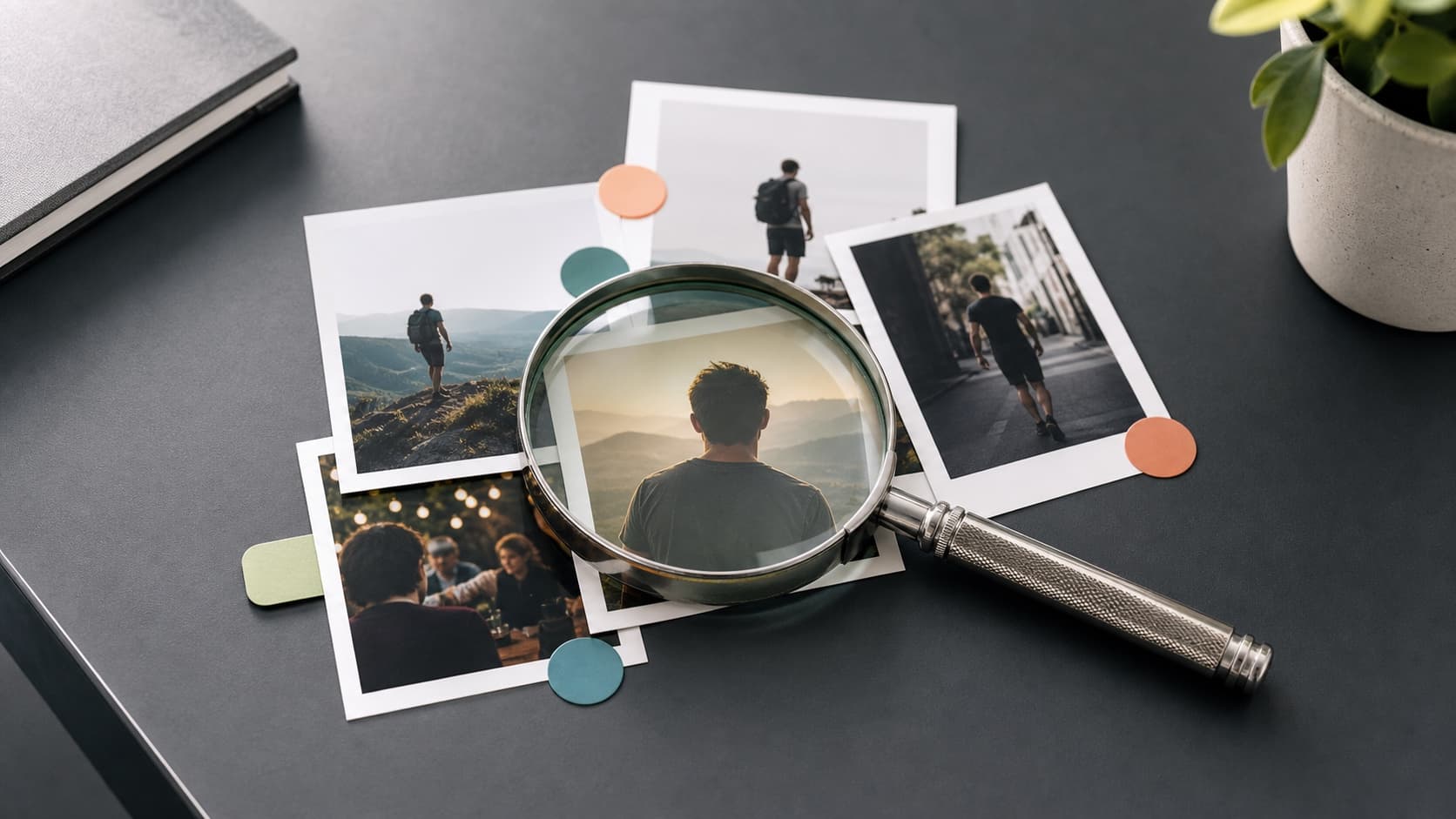
If you're asking "is my dating profile bad?", the answer is usually visible faster than people think. In 2020, Pew Research Center found that 71% of online daters said it was very important for a profile to include the other person's photo (Pew Research Center, 2020). That means weak signals often show up before anyone reads a prompt.
A bad dating profile is not a verdict on you. It is a profile that makes you hard to recognize, hard to trust, or hard to reply to. Start with photos, then check whether the rest supports them.
Key Takeaways
- Pew says 71% of online daters rate photos as very important.
- Check the lead photo before changing the whole profile.
- Variety, trust, and reply-friendly prompts matter too.
- Weak results can also come from visibility, activity, or app fit.
Sign #1: Is your first photo hard to read?
Your first photo is often the fastest honest diagnostic. If it is dark, cropped oddly, or hides your face, the profile can lose trust before anything else gets a chance. Pew Research Center found that 71% of online daters said the other person's photo was very important (Pew Research Center, 2020).
The issue is not whether you look perfect. It is whether someone can tell who you are in a few seconds, in normal light, without decoding sunglasses, distance, blur, or a heavy filter. If you want the broader process after this sign check, use a full dating profile audit.
Hinge's own product design points the same way. In 2026, Hinge says its Top Photo feature predicts which photo is most likely to get a Like and moves that image first (Hinge Help Center, 2026).
Quick first-photo test
Ask one blunt question: would a stranger recognize you in five seconds? If not, fix that before you touch prompts or premium features. Tinder also says profiles can be hidden if it cannot detect a valid face photo (Tinder Help Center, 2026).
What Online Daters Want to See in a Profile
- Photo
- 71%
- Relationship intent
- 63%
- Children
- 45%
- Hobbies/interests
- 36%
- Religion
- 25%
Free photo review
Find out what your dating photos are missing
Answer a few questions and upload your photos. Get your profile score, photo-by-photo feedback, and a clear plan for what to improve.
Free results. No signup required.
Sign #2: Your photo stack looks repetitive or low-effort
A repetitive stack can make a decent profile feel lazy. If every image looks like the same selfie in the same room, people learn almost nothing about you. Communication Research tracked 48 participants across 831 profile views and found that pictures drew initial attention first (Communication Research, 2022).
In 2026, Hinge says interests, candid photos, sports photos, and smiles tend to receive more Likes, while selfies, posed photos, filters, sunglasses, and photos with a potential significant other tend to receive fewer Likes (Hinge Help Center, 2026). Bumble's upload guidance also recommends variety that can show hobbies, social moments, pets, or travel (Bumble Support, 2026).
Photo variety check
Look at the stack as a set of jobs, not favorites. One photo should identify you fast. Another should widen the story. A third should add normal-life context. If two photos do the same job, cut one and move to better dating profile pictures.
Sign #3: Are selfies or filters doing too much work?
Selfies and filters become a problem when they make the profile feel less real than meeting you would. That is when a selfie-heavy stack starts to feel harder to trust. Frontiers in Communication published an experiment with 389 participants showing that visual presentation changed profile judgments and dating intentions (Frontiers in Communication, 2025).
One selfie is not a crisis. A selfie-heavy profile usually is. If every image looks arm's-length, over-controlled, or heavily edited, the profile stops feeling real. In 2026, Hinge explicitly lists selfies, filters, and sunglasses among photo types that tend to receive fewer Likes, and Bumble warns against effects that make the image harder to read (Hinge Help Center, 2026; Bumble Support, 2026).
The natural-photo test
Could at least one stranger-facing photo pass as you in normal light on a normal day? If not, the profile is asking people to trust a version of you that feels slightly off. That is enough to make a decent-looking profile feel bad.
Sign #4: Do your photos feel old or hard to trust?
Old or inconsistent photos create trust friction fast. If the images feel out of date or disconnected from how you look now, the profile starts failing on honesty, not looks. Pew Research Center found that 71% of online daters said photos were very important on a profile (Pew Research Center, 2020).
Old photos create expectation risk. The same goes for odd crops, only-head shots, or images that feel like they belong to a different phase of your life. Ask whether the photos set fair expectations for the person who might meet you.
Tinder's help guidance adds an important technical caveat. In 2026, Tinder says hidden profiles are not shown to other users and says a valid face photo should show a clear, well-lit full face (Tinder Help Center, 2026). That makes accuracy and legibility part of profile function, not just aesthetic taste.
The date-expectation test
Would someone who met you this week feel your profile prepared them honestly? If not, update the photos before you do anything else. A current, plain, believable photo usually beats an older photo that looked better once.
Sign #5: Do your photos show any real life context?
A clear face is not always enough. If your photos never show movement, hobbies, or normal-life context, the profile answers only what you look like, not what spending time with you might feel like. Pew Research Center found that 36% of online daters said hobbies and interests were very important profile information (Pew Research Center, 2020).
A clear face matters. After that, people also look for context: movement, setting, hobbies, warmth, and some clue about how your life actually feels.
In 2026, Bumble says photo variety can include hobbies, social moments, pets, travel, or adventure (Bumble Support, 2026). If this is your bottleneck, keep the fix practical and save the deeper execution work for later dating profile photo tips.
The context test
Can someone name one real thing about your life from the photos alone? If not, the profile may be clear but still not compelling.
Sign #6: Do your prompts give people no reason to reply?
Good photos can still stall when the text gives people nothing to do next. If your prompts are blank, generic, or overly polished, the profile becomes harder to answer. Pew Research Center found that 63% of online daters said the type of relationship a person is looking for was very important profile information (Pew Research Center, 2020).
Photos buy attention. Prompts decide what happens next. If the text is blank, generic, negative, or trying too hard to sound perfect, the profile becomes harder to answer. You need one or two lines that support the photos and make conversation easier.
The 2022 Communication Research eye-tracking study matters here because it found that people formed impressions from both pictorial and textual cues, not pictures alone (Communication Research, 2022). A readable profile pairs clear visuals with clear intent. If you keep drifting into generic profile errors, route out to broader dating profile mistakes men make.
The reply-hook test
Run one simple reply test: can a stranger read a prompt once and know what specific message to send? If not, the photos are carrying the whole profile alone. That is too much pressure for any stack to handle.
Sign #7: The problem might be activity, preferences, or visibility
Weak results are not always a photo verdict. Low activity, narrow preferences, location, and account state can all suppress traction, and Pew Research Center found that 54% of online daters said they had received too few messages from people they wanted, rising to 61% among men (Pew Research Center, 2020).
Activity, recency, preferences, location, app fit, and account state can all affect results. Tinder says it recommends profiles using factors that include activity and recency, not just profile content (Tinder Help Center, 2026). If the profile looks solid but traction is still weak, widen the diagnosis.
Next step by diagnosis
Profile problem vs visibility problem
| What you see | What to check first | Best next step |
|---|---|---|
| Weak opener, repetitive stack, vague prompts | Photos and profile text | Fix the profile first |
| Decent profile, low activity, thin reach | App behavior, filters, timing | Read no matches on dating apps |
| You cannot tell which photo is weakest | Outside evaluation | Get photo rating feedback |
If you cannot tell which photo is weakest, run a quick outside-review pass before you spend money. Ask one stranger which photo looks clearest first and which one they would cut. Cognitive Research found that people were worse at selecting flattering profile photos of themselves than strangers were (Cognitive Research, 2017).
When the profile clearly points to a photo bottleneck, do not buy reach first. Replace the weak visual input first.
If the issue is old, unclear, or low-variety photos, TinderProfile.ai can be a narrow practical bridge after diagnosis. It uses 2 to 5 uploaded photos to train a personalized model, packages start at $14, and results are delivered after model training in about 5 to 10 minutes. Keep the use case honest: dating-specific lifestyle coverage, not guaranteed matches.
Start with the smallest honest fix: clear opener, better range, one prompt worth answering. Then test again. If the whole account still looks muddy, step back and do the broader full dating profile audit.
FAQ
Is my dating profile bad if I get no matches?
Maybe. In 2020, Pew found that 54% of online daters had received too few messages from people they were interested in, including 61% of men (Pew Research Center, 2020). Start with photos and prompts, then check activity.
What is the biggest sign of a bad dating profile?
Usually it is the lead photo. In 2020, Pew found that 71% of online daters said the other person's photo was very important on a profile (Pew Research Center, 2020). If your first image is unclear or dated, the rest often never gets a fair read.
Are selfies bad for dating profiles?
Not always. In 2026, Hinge says selfies tend to receive fewer Likes than interests, candid photos, sports photos, and smiling photos (Hinge Help Center, 2026). Three versions of the same angle usually signal low effort.
Should I ask someone else to review my dating profile?
Yes. In 2017, Cognitive Research found that people were worse at selecting flattering profile photos of themselves than strangers were (Cognitive Research, 2017).
Should I fix photos or prompts first?
Fix photos first when the opener and stack are unclear. In 2022, the Communication Research eye-tracking study followed 48 participants across 831 profile views and found pictures drew initial attention first (Communication Research, 2022). Fix prompts first only when the photos are already clear.
A bad dating profile usually is not mysterious. It leaves visible clues: weak lead image, repetitive stack, trust issues, missing lifestyle context, flat prompts, or a diagnosis that confuses profile conversion with visibility. Start with the signs you can see. Then choose the next route on purpose, not in panic.
If the profile looks decent but the results still feel off, go deeper on no matches on dating apps. Diagnose first. Rebuild second.