


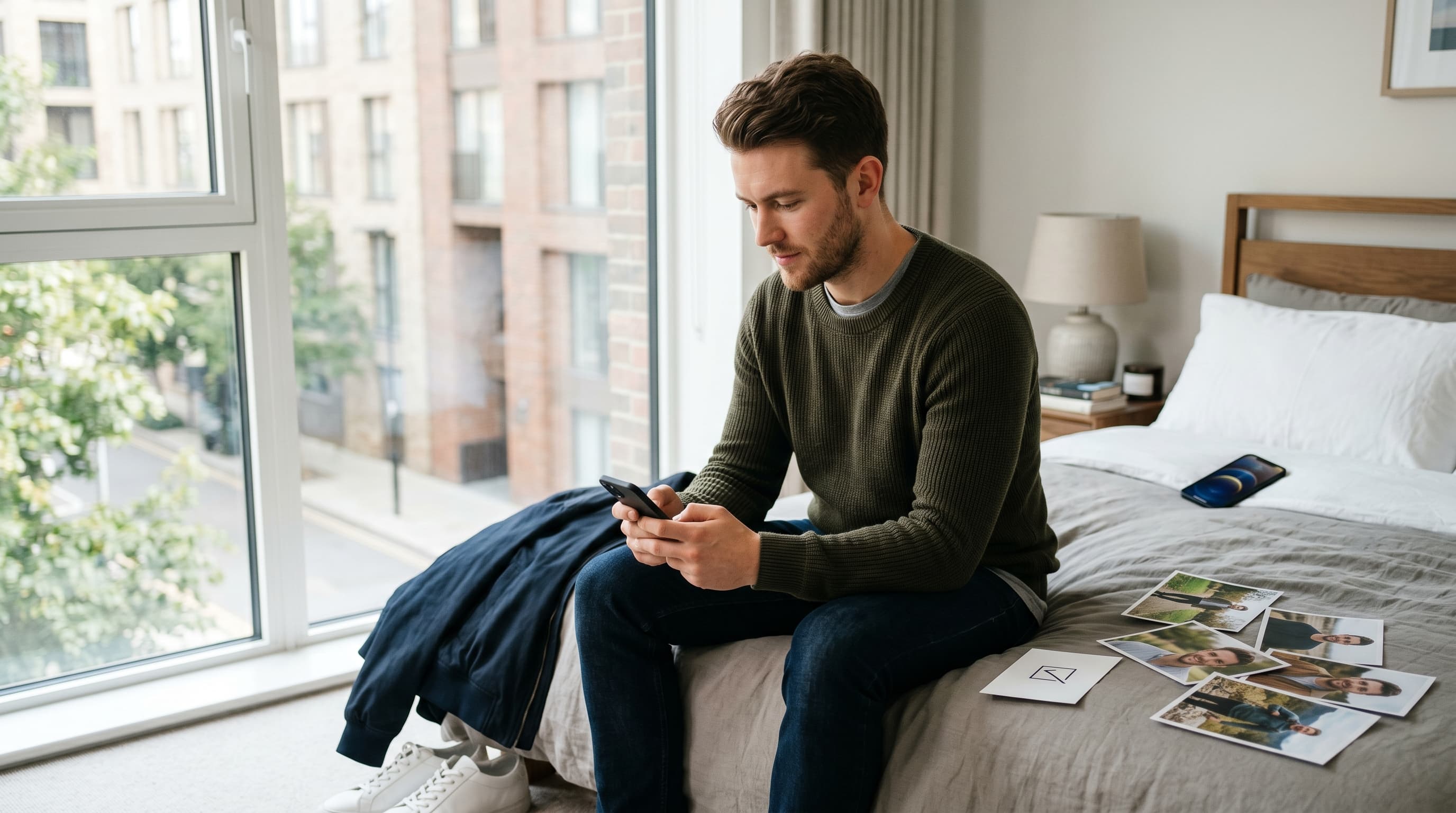
Bumble's 2026 guidance says profiles with 6 photos are nearly 2x more likely to get likes than profiles with 3 (Bumble Support, "Here's what Bumble data says about adding photos", 2026). That makes a dating profile review the smarter move before premium. Paid reach helps only when the page already turns attention into curiosity.
A useful diagnosis is not a roast or a vague score. It should isolate the bottleneck: lead image, gallery range, prompt clarity, trust cues, feedback quality, or true distribution.
Key Takeaways
- Separate conversion problems from visibility problems first.
- Bumble says 6 photos beat 3 by nearly 2x.
- Review photos, prompts, trust, and feedback before premium.
- Buy reach only after the profile already earns interest.
What a dating profile review should tell you
A 2022 SAGE eye-tracking study followed 48 participants across 831 profile views (SAGE, "What People Look at in Multimodal Online Dating Profiles", 2022). A useful dating profile review should name the account's real failure mode: persuasion after someone lands there, or exposure before enough suitable people see it. That split decides whether you need sharper inputs or broader distribution.
Different bottlenecks call for different fixes. Conversion issues show up after someone opens the card and keeps moving. Visibility issues happen before enough compatible people ever see it. Blend them together, and you pay in the wrong order. That's why this article doesn't repeat a full dating profile audit. The job here is narrower: decide whether you need stronger inputs, sharper feedback, or wider reach.
| Review result | What it usually means | Fix first | Premium next? |
|---|---|---|---|
| People see the profile but do not engage | Conversion problem | Photos, prompts, trust | Not yet |
| Profile gets some traction but too little reach | Visibility problem | Distribution test | Sometimes yes |
| Advice feels vague or contradictory | Feedback problem | Better review criteria | No |
Free photo review
Find out what your dating photos are missing
Answer a few questions and upload your photos. Get your profile score, photo-by-photo feedback, and a clear plan for what to improve.
Free results. No signup required.
Photo stack review comes first
Bumble's 2026 photo guidance gives the clearest reason to start with the gallery: accounts with 6 photos are nearly 2x more likely to get likes than accounts with 3 (Bumble Support, "Here's what Bumble data says about adding photos", 2026). Paid visibility is a late move when the opener, count, or range still feel weak.
Hinge reinforces that point in a different way. Its Top Photo feature uses a machine learning model to predict which profile photo is most likely to get you a Like and places that image first (Hinge Help Center, "What is Top Photo?", 2025). The first image decides whether the rest of the profile gets read.
| Photo-count checkpoint | What Bumble supports | Review takeaway |
|---|---|---|
| 3 photos | Baseline in Bumble's comparison | Treat this as thin unless every image has a clear job |
| 4 to 6 photos | Bumble's recommended working range | Build enough variety for face, lifestyle, social, and current context |
| 6 photos | Nearly 2x more likely to get likes than 3 | Use this as the practical target when you have six useful shots |
A strong review asks whether each image earns its place. One shot should establish your face quickly. Another should add lifestyle or social context. A third should widen the story. The hands-on clue is repetition: when three frames all do the same job, the gallery looks fuller than it really is.
The same Bumble help page says pictures are the first thing people see and that 4 to 6 work best (Bumble Support, "Uploading profile photos and videos", 2026). A thin lineup is a presentation problem before it is a paywall problem. For the deeper execution guide, go to dating profile pictures or these dating profile photo tips.
Quick photo review checklist
- Lead photo: clear face, current look, clean light, no guessing game.
- Count: at least enough range to feel complete, not just more duplicates.
- Variety: solo, social, lifestyle, and one normal everyday frame.
- Trust: no obvious old shots, confusing crops, or hidden-face photos.
Do your prompts and bio support the photos or fight them?
SAGE researchers found a measurable text penalty in 2020: profiles with language errors scored 4.29 on social-romantic attractiveness, versus 4.45 for error-free versions (SAGE, "Impression formation on online dating sites", 2020). Prompts and bio can undercut strong images, so give the words their own pass. They shape whether a match wants to answer.
The 2022 eye-tracking paper backs up that split. Participants used both pictorial and textual cues while forming impressions (SAGE, "What People Look at in Multimodal Online Dating Profiles", 2022). Berkeley Haas summarized the writing lesson this way: pages that show interest in getting to know and support the other person are more appealing than pages focused only on being understood themselves (UC Berkeley Haas News, 2024).
Prompt review should look for friction, not cleverness. Empty answers, vague bragging, defensive jokes, and sloppy wording make a match feel like more work. Photos earn the pause. Text either deepens it or kills it.
The "want to know" test
Run three quick checks. Does the text sound like a real person, or a template? Does it give someone an easy reply path? Does it show interest in meeting someone, not just being admired? If the answer is no, the wording is fighting the photos.
Trust and completeness signals
Bumble's 2026 upload guidance recommends 4 to 6 photos because people need enough context to judge a profile (Bumble Support, "Uploading profile photos and videos", 2026). Trust and completeness deserve their own check too. Missing basics, stale details, or low-effort cues can drain interest before reach is even the problem.
Most people trust profiles that feel current, clear, and finished. They trust them less when the photos look outdated, the written sections feel half-done, or the vibe changes wildly from frame to frame. "Mysterious" usually reads as incomplete, not intriguing.
Hinge's 2026 no-match guidance points users back to sharper photos, better prompts, quality likes, and wider preferences before paid reach (Hinge Help Center, "Why Aren't I Getting Any Matches?", 2026). When the whole account feels shaky, broad troubleshooting matters more than subscription mechanics. That's where our guide to no matches on dating apps becomes the better next step.
Which feedback source should you use?
Only 33.5% of participants in the 2020 SAGE study noticed the planted language errors (SAGE, "Impression formation on online dating sites", 2020). Different reviewers miss different flaws, so assign each feedback source a job. Friends catch recognizability. Strangers expose first-swipe friction. Paid help earns trust only when the criteria are explicit.
| Feedback source | Best for | Common blind spot |
|---|---|---|
| Self-review | Fast obvious fixes | You normalize weak habits |
| Friends | Recognizability, authenticity | They already know you |
| Strangers or communities | First impression friction | Advice can be noisy |
| Paid reviewer or tool | One defined problem | Weak if the criteria are vague |
A practical sequence works better than collecting ten vague opinions. Start with self-review, add one blunt outside read, then bring in a focused tool or paid reviewer only for the part still in doubt. In actual profile triage, the messy comments usually become useful only after you sort them into buckets: opener, gallery variety, written hooks, trust, and reach. If the real uncertainty is visual, start with photo rating feedback, not a full rewrite of everything.
When should you buy premium after a dating profile review?
Pew reported in 2023 that 35% of U.S. online dating users had paid to use a site or app (Pew Research Center, "Key findings about online dating in the U.S.", 2023). Premium makes sense after a diagnosis only when the account already gets some response and the remaining issue is reach, filtering, or workflow.
The 2026 product docs fit that logic. Tinder Gold includes 1 monthly 30-minute Boost, Tinder Platinum adds weekly First Impressions of 140 characters or less and a 7-day Likes Sent view, and Hinge says Boost runs for 1 hour while Superboost runs for 24 hours (Tinder Help Center, "Tinder subscriptions", 2026; Tinder Help Center, "First Impressions", 2026; Hinge Help Center, "Why Aren't I Getting Any Matches?", 2026). Those mechanics buy placement, priority, and sorting. They do not repair the card someone judges.
Profile problem vs visibility problem
| Situation | What it means | Fix first | Premium worth testing? |
|---|---|---|---|
| Zero likes or near-zero response | Conversion problem | Photos, prompts, trust | Usually no |
| Some response, wrong fit | Filtering problem | Preferences, profile clarity | Sometimes |
| Good profile, thin reach | Visibility problem | Exposure test | Yes |
| Too much inbox noise | Workflow problem | Sorting tools | Yes |
Still deciding at the category level? Read whether paid dating apps are worth it. This article is narrower: is premium the next best spend after your review?
What should happen if photos are the bottleneck?
TinderProfile.ai asks users to upload 2 to 5 photos and says paid training results arrive in about 5 to 10 minutes (TinderProfile.ai, 2026). When the image set is clearly the bottleneck, fix that asset before buying more reach. A photo tool becomes practical only after the diagnosis shows weak, repetitive, or outdated material.
If the review says the whole account needs work, use the full profile repair checklist instead of treating photos as the only task.
Keep the use case narrow. You may look current in real life, but your gallery doesn't show it. Start with a clearer lead image, better variety, and more dating-specific context. Only when you still do not have enough usable material does a photo tool earn a place.
For the actual rebuild, route out instead of turning this article into a full fix checklist. Use dating profile photo tips when you need better raw material, and dating profile pictures when you need a stronger six-photo structure.
FAQ
Is a dating profile review worth it?
Yes. SAGE's 2022 eye-tracking study followed 48 people across 831 profile views and showed that both visuals and text shape impressions (SAGE, "What People Look at in Multimodal Online Dating Profiles", 2022). A useful review separates visuals, text, trust, and visibility so you know what to fix next.
Can premium fix a bad dating profile?
Not by itself. Hinge says Boost shows your profile to more people for 1 hour, and Superboost runs for 24 hours (Hinge Help Center, "Why Aren't I Getting Any Matches?", 2026). That can increase exposure, but it won't make weak photos or flat prompts more persuasive.
Should I ask friends, Reddit, or a paid reviewer to review my profile?
Use a mix, but give each source a job. The 2020 SAGE study found that only 33.5% of participants noticed the planted language errors, which shows people miss different problems (SAGE, "Impression formation on online dating sites", 2020). Friends check recognizability, strangers expose first impressions, and paid reviewers help only when their criteria are clear.
What is the first thing to check in a profile review?
Start with the lead image and the full gallery. Bumble's 2026 guidance says 6-photo profiles are nearly 2x more likely to get likes than 3-photo profiles, and its upload guide also says 4 to 6 photos work best (Bumble Support, "Here's what Bumble data says about adding photos", 2026; Bumble Support, "Uploading profile photos and videos", 2026).
What should I do if the review says my photos are weak?
Rebuild the gallery before you buy more reach. Bumble's 2026 upload guidance says 4 to 6 photos work best, so aim for a complete set with one clear opener, real variety, and current context (Bumble Support, "Uploading profile photos and videos", 2026). Then test the account again before you spend on visibility.
Start with diagnosis, repair the conversion signals second, and test premium only when the account already earns some response. For a broader checklist, start with the full dating profile audit. If the spend question is still open, continue with whether paid dating apps are worth it.